Appendix B - Chassis & Engine Compartment Paint Colors

I will be fairly general because there are many different colors, shades, and gloss levels found under the hood, not to mention the many types of plating (that could be a book all by itself). Instead, I will be rather generic for home restorers so they can be close enough for the weekend outdoor car show and be proud to show off their engines and chassis.
Many home restorers are happy just to have black parts black and plated parts plated, while others have asked for specific paint codes. I will try and help those who are doing home restorations, since most shops and professional restorers will know the specific colors needed already.
As with any painting steps, make sure you follow all the guide-lines detailed in chapter 6. All of your efforts will be for naught if they are not followed to the fullest. It is also understood that many of you may be restoring your engine compartment with some of the major components still installed, such as the engine and transmission, and will have to work around those. As with any painting process, cleanliness is critical.
Some of you will be using aerosol paints rather than shooting through a gun. If you are restoring your engine compartment, with the engine and transmission in Items such as carburetor place, you will get far better results removing all the peripherals on the engine and under-hood to allow you more clearance to the compartment without clutter in the way. Items such as carburetor, distributor, alternator, exhaust manifolds, plug wires, pulleys, radiator, wiring harness, and many other items can be removed so you can better clean the area and spray on she new primer and paint without getting those items covered in overspray. Ultimately, it is best if you are leaving the engine and transmission in the car to lave just the engine long block, brake master cylinder and booster, and wheel tubs. Remove as much of everything else that you can. Be sure to take photos of the components and their location.
It is imperative to clean and spray in a well-ventilated area, wear proper clothing, and take appropriate action to cover the body and any areas you are not painting to protect them from overspray.
Underhood Details
The basic outline provides the colors that you will be working with. It will get you started toward a presentable undercarriage and engine compartment.
- Frame, front control arms, and lower rear trailing arms:
semigloss black (if painting black, the upper trailing arms are
flat black). Some plants did not paint the rear trailing arms or
transmission crossmember, so these could be painted natural
steel as well.
- Rear differential: same semigloss black or natural steel,
depending on the plant.
- Front and rear coil springs: either natural cast iron or
semigloss black.
- Front and rear sway bars: semigloss black or natural cast
iron.
- Shocks: shock gray.
- Steering linkage: natural cast iron.
- Brake calipers: semigloss black or natural cast iron.
- Caliper brackets: gold cadmium.
- Disc brake backing plates: original galvanized steel. Bright
zinc is acceptable when restoring.
- Tie-rods: natural cast iron.
- Tie-rod sleeves and clamps: natural cast iron.
- Steering box: (power or manual) natural cast iron with
natural aluminum top plate.
- Firewall, wheelhouses, and core support: semigloss black.
- Radiator: gloss black.
- Cooling fan: gloss black.
- Crank, water pump, and power steering pump pulleys: gloss
black.
- Power steering pump: gloss black.
- Power steering bracket: gloss black.
- Upper/lower alternator braces: semigloss black.
- Alternator: natural aluminum.
- Alternator fan: originally galvanized, but high-performance
is bright zinc, low-performance is semigloss black.
- Fan clutch: natural aluminum with gold cadmium center face
and natural steel shaft mount.
- Heater housing on firewall: gloss black (Kansas City plant
sprayed undercoating over the top edge and face of the
firewall).
- Heater fan housing: semigloss black.
- Air-conditioner dog house: natural black fiberglass.
- Air-conditioner compressor and brackets: semigloss black.
- Hood hinges and upper/lower hood latch: dark gray phosphate.
- Most small underhood brackets: semigloss black.
- Exhaust manifolds: natural cast iron (special paint for
exhaust).
- Brake booster proportioning valve bracket, and master
cylinder cover: gold cadmium.
- Master cylinder: either semigloss black or natural cast
iron.
- Proportioning valve: either semigloss black or natural cast
iron.
- Metering valve: either natural cast iron or natural brass,
depending on the plant.
- Windshield washer pump: the base is natural aluminum and
canister is bright zinc.
- Horns: gloss black.
- Voltage regulator: gloss black cover with galvanized or zinc
base.
- Ignition coil: gloss black.
- Coil bracket: galvanized or zinc.
- Distributor: natural cast aluminum.
- Fuel and brake lines: natural steel.
- Battery tray: semigloss black.
- Intermediate steering column shaft: semigloss black.
- Rag joint: natural cast iron.
- Upper CV joint housing on intermediate shaft: semigloss
black or dark gray phosphate.
- Engine, cylinder heads, water pump, oil pan, rocker arm covers
(when not chrome), intake (when not aluminum), harmonic
balancer: all Chevrolet orange. (chrome rocker arm covers and
aluminum intake may have very slight Chevrolet orange overspray.
The engine painters simply held a piece of handy cardboard
against the rocker arm covers to prevent as mush overspray as
possible. The same holds true for hoses like the intake to water
pump bypass hose, and naturally, all visible bolts that were
applicable at the engine assembly plant like water pump, front
cover, oil pan, etc.).
- Air cleaner (when painted): semigloss black.
- Bellhousing: natural cast aluminum with very light Chevrolet
orange overspray where it is bolted to the engine block.
- Transmission: natural cast aluminum (both manual and
automatic).
- Driveshaft: natural steel.
- Fuel tank: natural galvanized steel.
- Fuel tank straps: semigloss black.
- All parking brake cables: natural steel.
- Bottom side of hood: semigloss black.
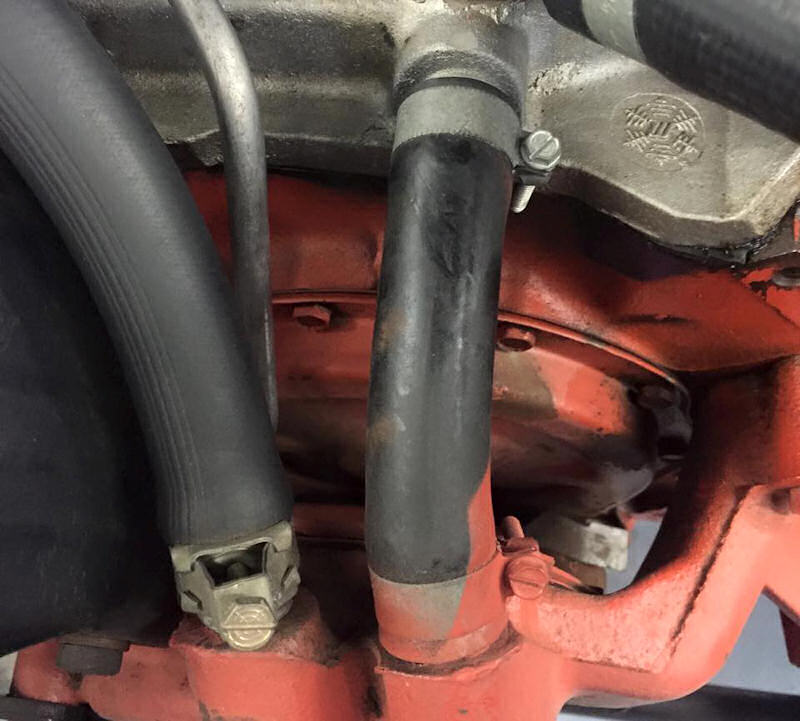
Note overspray on intake to water pump bypass hose.
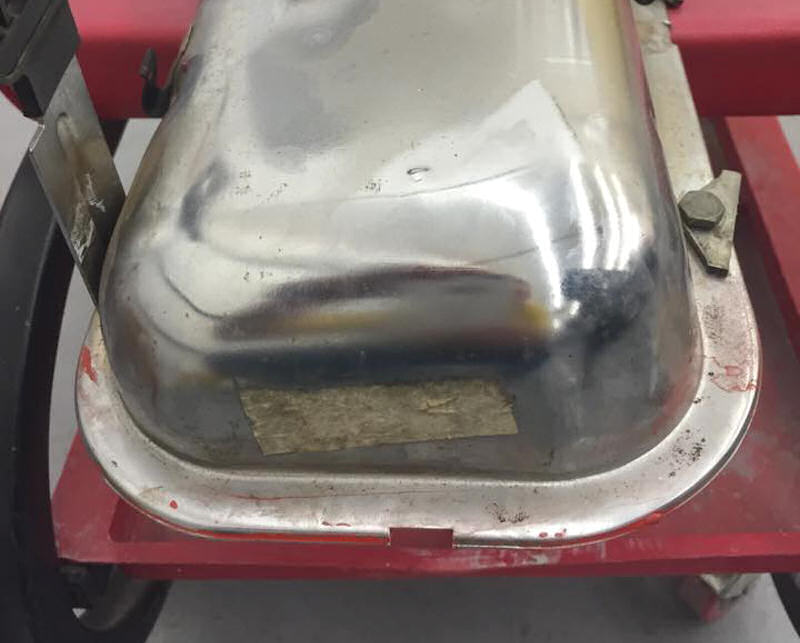
Over time, or due to the owner cleaning them, what little overspray
on the rocker arm covers will be worn away.
| © Chevelle Restoration |
   |
1970 Chevelle SS396/SS454 Build Sheet Decode Program 1964-1972 Ship Manuals & Parts Catalog 1953-1972 Chevrolet Production Numbers |