Engine and Driveline
Engine Restoration
When doing a Concours restoration I would suggest leaving the engine and transmission rebuild towards the end of the process. Your restoration will, undoubtedly take some time depending on the depth of your restoration, your finances, acquisition of parts, and work you may have to farm out. There is no point to having your freshly rebuilt/restored engine and transmission sitting an engine stand and storage pallet for months on end gathering dust and drying out. However, if there are original or date coded pieces missing like distributor, carburetor, starter, alternator, pulleys, air cleaner, etc. that have been changed or replaced over the years, now would be a good time to make a list and start chasing those parts down as many of those pieces may be very hard (not to mention expensive) to come by.
When the time does come, you should have already decided at this point which route your restoration is going to take - a full on Concours restoration and show car that will not see street driving for a few years, a nicely restored/rebuilt weekend cruiser and local car show participant, or a daily driver where reliability is key.
For the purpose of this book, we are going to assume your goal is a Concours quality restoration for show purposes in many instances. Other restoration or rebuild levels will, naturally, be less strict on engine appearance or modifications you may choose to make. This means the outward appearance of the engine components is paramount. Correct casting numbers, correct part numbers, acceptable casting dates, markings, and, above all, correct finishes on the numerous pieces are what judges and critics will be looking at.
If you are lucky enough to have acquired a good, solid, survivor car that has never had the engine or transmission rebuilt you are ahead of the game here. You may only need to acquire original equipment manufacturer (OEM) pieces that would have been replaced over the years due to normal maintenance.
Items such as inline fuel filters, air filter elements, ignition
pieces like distributor cap, spark plug wires, and spark plugs are readily
available in the aftermarket and you may even be lucky enough to find
quality, new-old stock (NOS) replacements.
Spark plug wires were date coded according to the quarter and year and
this date coding was for internal quality control and may be significantly
earlier than the car they were installed on. There was generally quite
a lead time between 4 to 12 months from the date the wires were produced
and the time they reached the assembly line. A typical example would
be 2-Q-69 for 2nd quarter, 1969 meaning this wire may not get to an
engine on the assembly line until the 3rd or 4th quarter of production
and could easily be correct for 1970 models.
1st quarter - January, February, and March
2nd quarter - April, May, and June
3rd quarter - July, August, and September
4th quarter - October, November, and December
According to GM specifications, all small block Chevrolet V8 engines (283-302-307-327-350-400) have 90° spark plug terminals and 180° terminals on the distributor and ignition coil. When the 396 V8 was introduced in 1965 a new type of wire was used with an improved insulation to better cope with the higher exhaust manifold and underhood temperatures since (except in 1965) there were no heat shields between the exhaust manifold and the spark plug itself. In addition to the new insulation, a new silicone spark plug terminal boot was introduced and is gray as opposed to black used on L6 and small-block V8s. All spark plug terminals were 135°with the exception of the #7 plug which received a 90° terminal due to clearance issues while the distributor and ignition coil continued to use 180° terminals.
Quality reproductions of upper/lower radiator hoses, heater hoses, vacuum hoses, clamps and such are available in the aftermarket with correct markings. Chances are if your car has ever had any of these hoses replaced the original spring clamps or tower clamps were replaced with common worm gear style clamps. Do a little research now to see just what type of clamps you will need for your application. Also note engine paint overspray. The basic engine assembly was painted at the Tonawanda engine plant and while some care was taken to not paint things like hoses, aluminum intake manifolds, and chrome rocker covers (1970 only), overspray was inevitable.
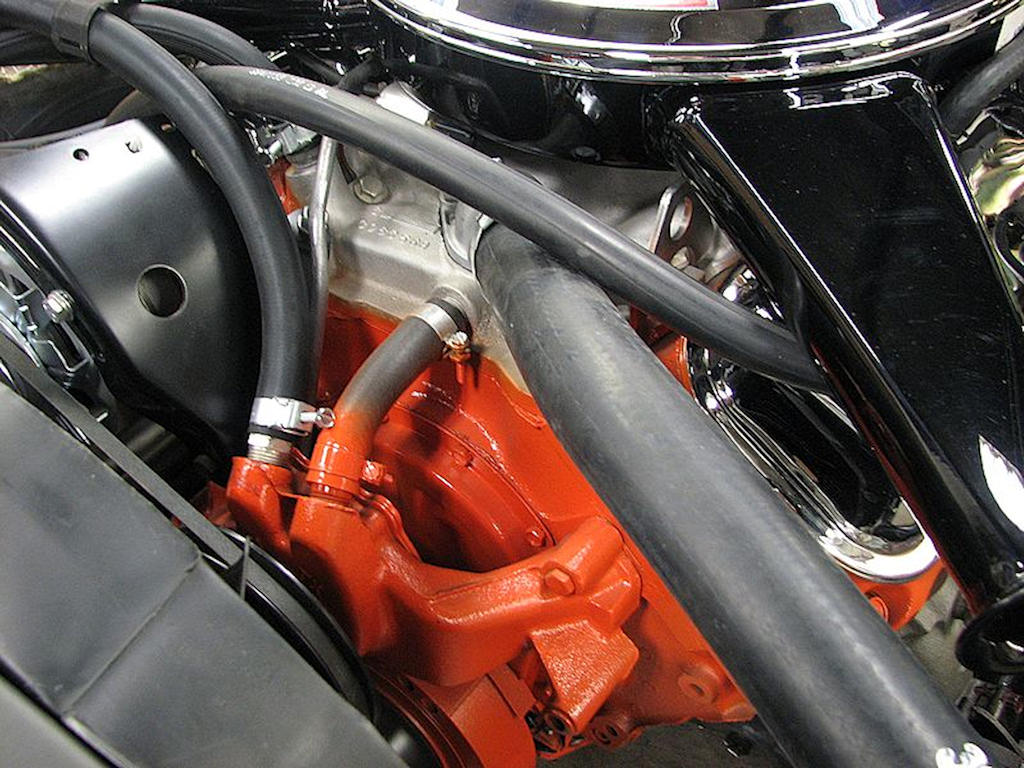
There were several types of hose clamps were used depending on their
particular use. These hose clamps are often replaced with worm-gear
type clamps that are not correct for a restoration.
The top radiator hose for 1970 402 and 454 engine Chevelles will most often depend on other equipment ordered. Two top radiator hoses were used on 1970 SS optioned Chevelles with either broadcast code “SV” or “KY.” Their use most often depended on other equipment but not always.
The “SV” coded hose has a pronounced “S” shape designed to clear the air conditioning compressor on air condition optioned Chevelles. However this same “SV” coded hose has been documented on build sheets for Chevelles without the air conditioning option as well on many 402 and 454 engine's build sheets.
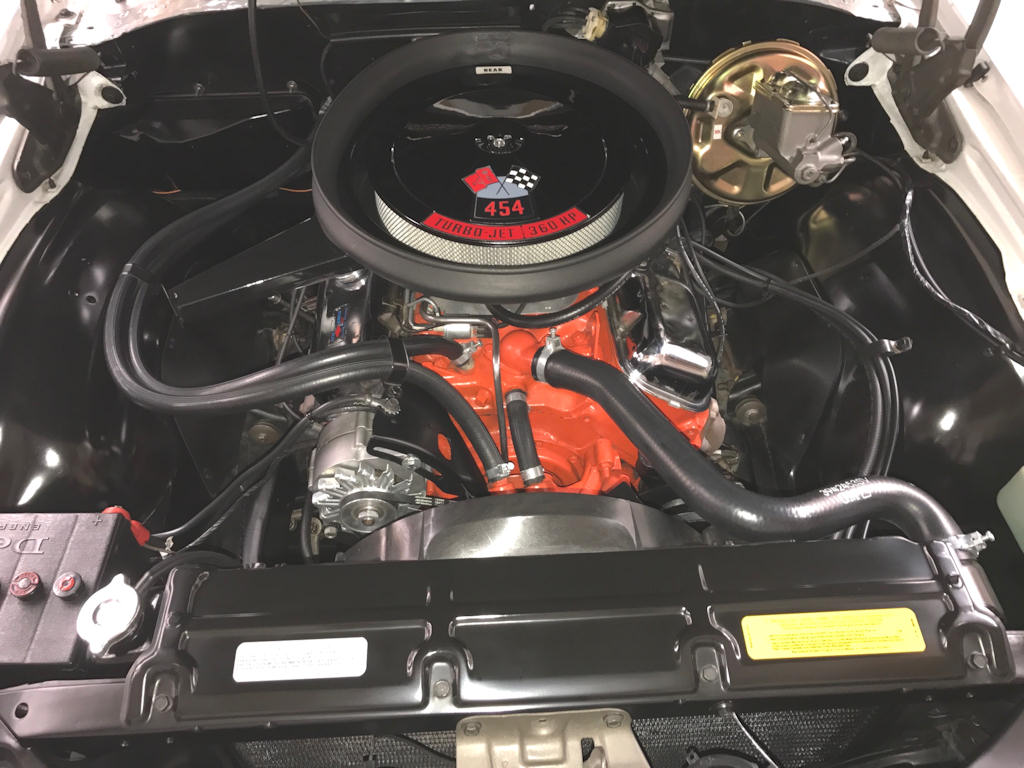
Upper radiator hose markings with part number (#3942453) and broadcast
code SV. Two upper hoses were used for 1970 with broadcast codes SV
or KY. While the SV-coded hose has a distinctive “S” shape to clear
the air conditioning compressor and it has been found on numerous, documented,
non-air conditioned 1970 Chevelles as well. Shown here with LS5 engine
without air conditioning. (Photo Courtesy LS5 Registry).

Upper radiator hose markings with part number (#3942453) and broadcast
code SV. Two upper hoses were used for 1970 with broadcast codes SV
or KY. While the SV-coded hose has a distinctive “S” shape to clear
the air conditioning compressor, it has been found on numerous, documented,
non-air conditioned 1970 Chevelles as well. Shown here with LS5 engine
and air conditioning. (Photo Courtesy LS5 Registry).
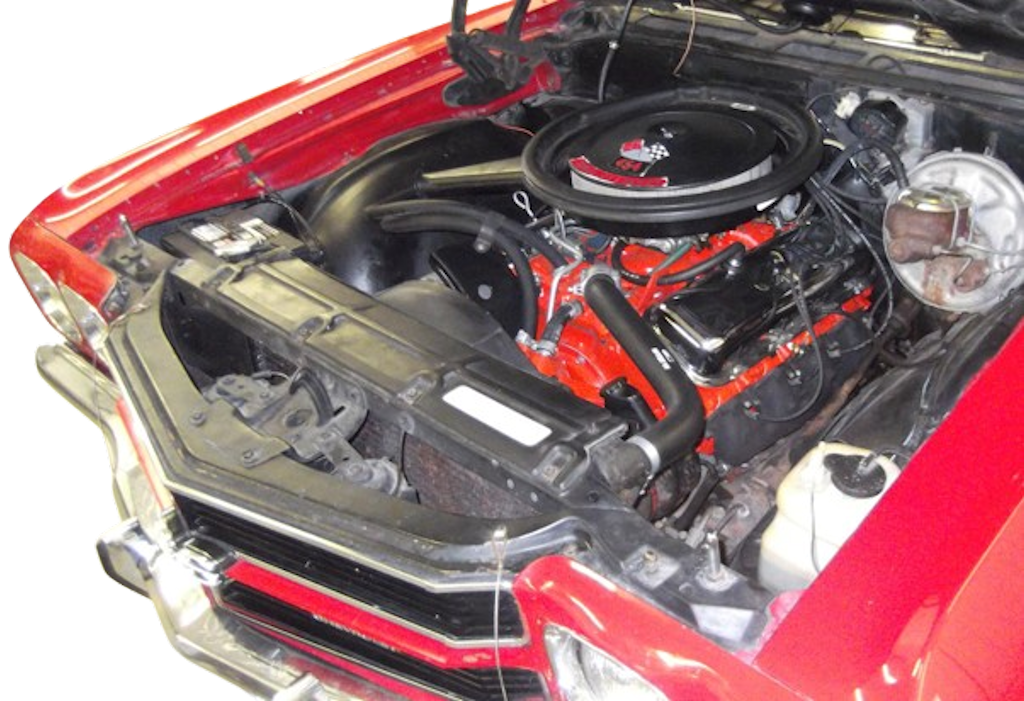
Note the difference with the KY-coded hose used (normally) on
non-AC optioned 1970 Chevelles.