Engine and Driveline
Radiator/Thermostat/Pressure Cap/Fan
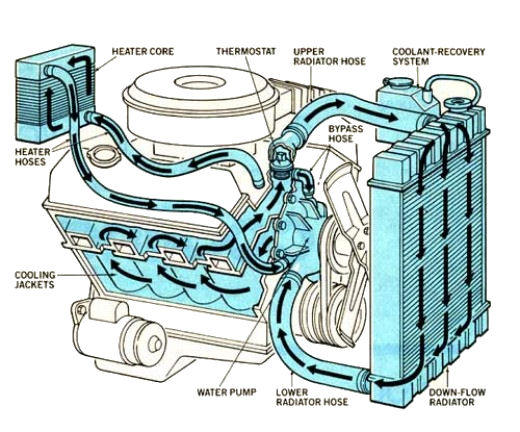
Basic cooling system.
Let us begin this by clearing up some terminology. It seems to be popular to misname various automobile parts for one reason or another. Some terms just seem to roll-off-the-tongue easier than others and sometimes it is just a matter of “that’s what everyone calls it…” Does not matter what people call it if it is wrong. Concerning radiators in Chevelles, and most other automobiles, radiators have one core, not two, not three, and not four. There is no such animal as a ‘3-core’ or ‘4-core’ radiator. Radiators have 2, 3, or 4 rows of cooling tubes but only one core. The particular engine, transmission, and air conditioning play a big part in the factory’s selection of the proper radiator for that application. For example, automatic transmission fluid is cooled by passing through a tank built into the radiator so an automatic transmission car needs the connections for the transmission cooling lines where a manual transmission car does not.
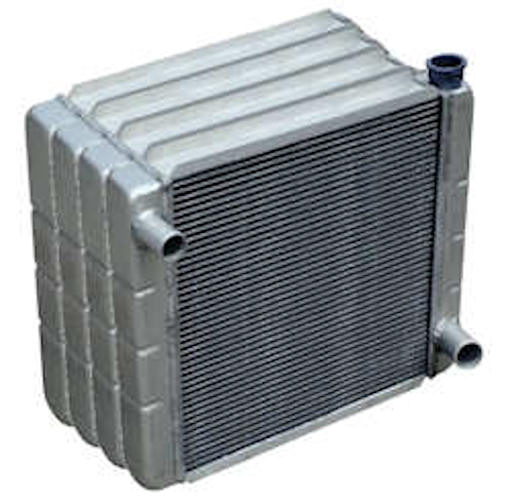
This is what a 4-core radiator would look like.
A car equipped with factory air conditioning will generally get a larger radiator with more cooling rows than the same car without air conditioning.
There are different radiators based on the engine size, transmission type, and whether the car was ordered with air conditioning or not. In 1970 neither the L78 396/375 horsepower engine nor the LS6 454/450 horsepower engine could be ordered with air conditioning. These two engines received the same heavy duty radiators as the L34 396/350 horsepower and LS5 454/360 horsepower engine when those were ordered with air conditioning. The same heavy duty/air conditioning radiator could be ordered as an option on any L34 or LS5 without air condition through RPO V01.
Many aftermarket aluminum radiators will have larger cooling tubes than factory radiator units. A two-row aluminum radiator with 1-inch cooling tubes can often do the same job as a three-row brass radiator with smaller cooling tubes. This book will not get into the discussion of which is better, aluminum or brass, as each has their camp of followers and their own data showing their material is better than the other. If you are restoring your Chevelle then a correct brass radiator is the way to go; if you are rebuilding your Chevelle and wish to change to an aluminum radiator, that is up to you.
The same holds true for fan shrouds and fan clutches vs. solid blade fans vs. electric fans. When doing a factory correct restoration, use what the factory used. Fan shrouds perform a valuable service by helping direct air flow through the entire surface area of the radiator. Using a fan by itself will only direct air through the radiator that is equivalent to the surface area of the fan itself. To some extent fan shrouds also help reduce under hood engine noise by reducing turbulence created by the fan. As a rule of thumb your fan blade should be about half in and half out of the fan shroud, putting the fan as close to the radiator as possible is not necessary when using a fan should. A fan shroud can also assist in safety by reducing the chance of getting your hands, shift sleeve, etc. caught by the fan as well as keeping foreign debris from entering the fan’s path and causing damage. Many aftermarket parts suppliers sell “CAUTION FAN” stickers decals to put on your fan shroud – Chevrolet did not use these. I suppose if one needs to be reminded not to put their hands in a moving fan these decals can serve a purpose; if you are correctly restoring your Chevelle, leave it off.
The cooling system’s thermostat is another subject with a lot of misconceptions about their use and purpose. Thermostats come in various temperature settings, 160°, 180°, and 192°-198°. What do these degree ranges mean? The temperature indicates when the thermostat begins to open to allow coolant to flow through the cooling system. A ‘cooler’ thermostat will not make your car run cooler; a cooler thermostat will only open sooner than a ‘hotter’ thermostat. When the engine is cold the thermostat’s job is to allow the engine to warm up to a desired operating temperature.
A thermostat allows the engine to circulate its coolant internally until the designated temperature of the thermostat is reached and allows coolant to flow into the top of the radiator. A thermostat is not designed to cool and engine but rather to allow the engine to come up to operating temperature. Thermostats come in various degrees of operation; 160°, 180° and 192°-198°. This is the temperature the thermostat begins to open. Chevrolet engines of this era were equipped with 192°-198° thermostats – for a reason. The car’s cooling system, ignition timing, etc. were designed around these temperature range parameters for normal operations.
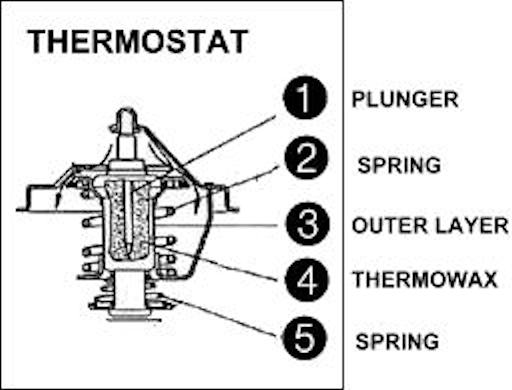
Typical thermostat.
A small cylinder is located vertically in the center of the thermostat and is filled with a wax that begins to melt at the designated temperature of the thermostat. A plunger connected to a valve presses into this wax as it melts pushing the plunger into the wax and opening the valve to allow water to circulate. When the engine is shut off, or at least cools down below the operating point of the thermostat, the wax begins to solidify and pushes the plunger back up via the spring and closes the valve.
Some people like to drill a couple of 1/8" holes in the valve to allow coolant to circulate into the radiator before the coolant has had a chance to get warm enough to open the thermostat. While this does work in a warm climate where it doesn't take the engine long to produce enough heat to open the thermostat, it might not be such a good idea when weather is cooler. It'll take longer for the engine to warm up thereby taking longer for the thermostat to open and give you heat through your heater or warm enough air to use your defroster.
There is debate by many people that believe if they remove the thermostat they will be able to solve hard to find overheating problems. This couldn't be further from the truth. Removing the thermostat will allow uncontrolled circulation of the coolant throughout the system. It is possible for the coolant to move so fast, that it will not be properly cooled as it races through the radiator, so the engine can run even hotter than before under certain conditions. Other times, the engine will never reach its operating temperature. On computer controlled vehicles, the computer monitors engine temperatures and regulates fuel usage based on that temperature. If the engine never reaches operating temperatures, fuel economy and performance will suffer considerably.
There are also many Chevelle owners that will remove the water bypass system on a Mark IV engine by simply plugging the hole in the front of the intake manifold and the top of the water pump. Some state they’ve done this for years with no ill effects. While it may clean up the top and front of the engine, it’s not always a good option to choose. The Mark IV engine was designed to have this bypass system to allow coolant to flow throughout the engine block and cylinder heads to regulate the temperature of the coolant until the thermostat opens and begins to stabilize the coolant temperature in the system. The small block Chevrolet engine has this coolant bypass system incorporated into the water pump itself, it is just not as readily apparent. Ever notice when you replace a water pump on a small block engine the water pump to block gaskets have what appears to be 3 mounting holes but only two bolts per side? One of those mounting holes is actually for the coolant bypass system on the passenger side of the engine block.
Radiator Pressure Cap
Another variable in engine cooling is the radiator pressure cap. Most people know that water begins to boil at 212° Fahrenheit at normal atmospheric pressure (14.7 pounds per square inch) at sea level. With a 50-50 mixture of water and antifreeze it goes up to about 225° or so. As you increase altitude from sea level the atmospheric pressure decreases and, therefore, lowers the boiling point of water. With each 500-feet increase in elevation, the boiling point of water is lowered by just under 1°F. For example, at altitude of 7,500 feet, water boils at 198°F. Not much but it does. For example Denver, CO. is about 12 pounds per square inch and lowers the boiling point of water to 202°. With a 192°-198° thermostat in place that does not give much room for error. However, water under pressure will actually raise its boiling point. Chevrolets of this era were equipped with a 15 pound pressure cap, effectively raising the atmospheric pressure to the equivalent of 30 pounds per square inch and thereby the boiling point of water to 250°. Antifreeze will also lower the temperature water will freeze. Pure water will freeze at 32° where a 50-50 mixture of water and antifreeze will lower that to about -35°. Different mixtures will, naturally, give you different temperatures of freezing or boiling.
Something to be cautious of, the coolant in your system will increase in temperature when you shut the engine off since it is not being circulated through its cooling cycle. Expect the coolant temperature to increase by 20°-30° if not more depending on the outside air temperature. If your water temperature gauge is reading too high or your temperature warning lamp comes on, find a place to pull off the roadway and let the engine cool down by itself. Do not attempt to remove the radiator cap until the engine has cooled down and pass up the temptation to pour cool water over the radiator to cool the engine down.
Fan Clutch
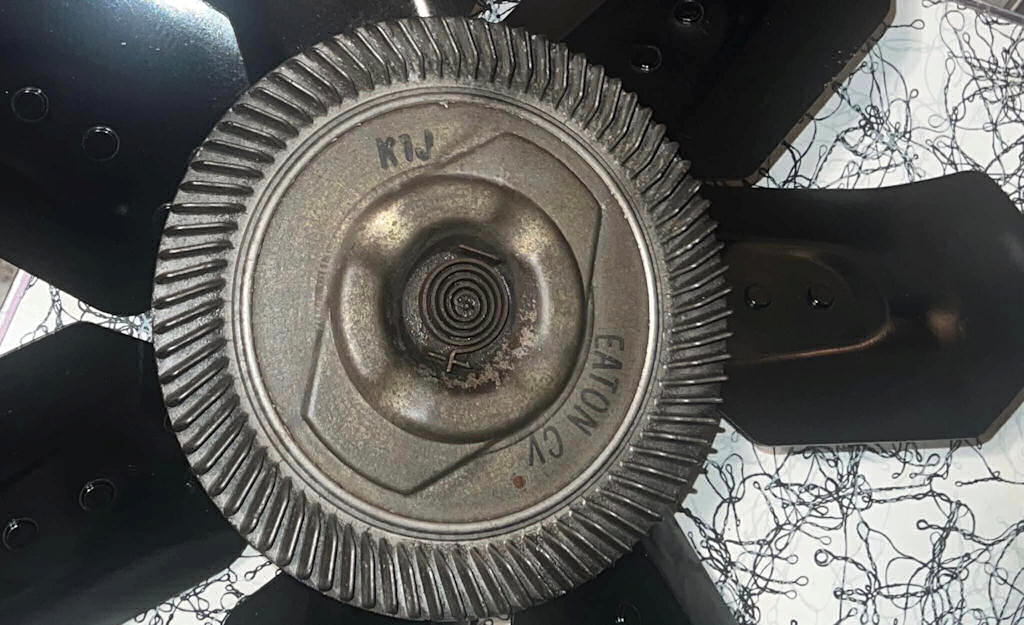
Rebuilt and restamped fan clutch assembly.
The fan clutch is a valuable piece of equipment for your Chevelle. The fan clutch is a thermostatic device, which means its operation is based on temperature, and is mounted on the water pump pulley. The fan clutch spins loosely until the temperature reaches a certain level, then it fully engages so that the fan works at maximum efficiency.

The fan clutch your Chevelle should have is shown in box #21 on
your build sheet.