Engine and Driveline
Rear Axle Housing
The rear axle housing does not have a partial VIN stamped on it. It does, however, have a center section casting number and casting date along with a stamped rear axle gear ratio and axle housing assembly plant on the axle tube.
| 10-bolt Casting Number | Year |
| 3939390 | 1964 |
| 3959139 | 1965(1) |
| 3863495 | 1965 |
| 3875744 | 1966 |
| 3894938 | 1937 |
| 3917123 | 1968 & 1969 |
| 3969277 | 1970 - 1972 |
| 12-bolt Casting Number | Year |
| 3859140 | 1965 |
| 3775745 | 1966 |
| 3894969/3775745 | 1967(2) |
| 3717124 | 1967 - 1969 |
| 3959038 | 1969(3) |
| 3969278 | 1970 - 1972 |
(1) Reported but not verified with photos
(2) Rear ends with this casting number have been found on
1966 Chevelles with casting date April 18, 1966 and 1967 Chevelles
with stamped assembly date of July 5.
(3) At least 1 example dated April 29, 1969 has been
found in a very early built 1970 Monte Carlo and stamped CKD 0815B
The center section casting number and casting date are located in the webbing. The casting date is in the format of a letter for the month, a 1- or 2-digit number for the date, and a single digit for the year. For example A 8 0 would be for January 8, 1970 and E 11 0 would be for May 11, 1970. Letters A through L are used for the months January through December.
The 1964 through 1969 rear end assembly and ratio codes generally follow the format of a 2-letter prefix code for the ratio, a 1- or 2-digit number for the month, a 1- or 2-digit number for the day of the month, and the rear axle assembly plant code letter. The stamped letters and/or numbers were individually stamped and not often very deep and certainly not very "neat." Sometimes the letter "E" was stamped to indicate Eaton Positraction and sometimes not, depending on the person stamping the axle housing. Since the two-letter prefix code would identify a Positraction over an open rear end, it may have been considered redundant by the person at the time.
The 1970 model year saw the introduction of a 3rd letter to the ratio code. This 3rd letter is the letter "C" for Chevrolet, so a 1970 ratio code might read CCF where CF is the ratio code. A 1970 example would be something like CCF 0821B for a Chevrolet Positraction 3.31:1 built August 21 at the Buffalo, NY axle assembly plant. Whether the plant changed their standard operating procedure or not is not clear but most Buffalo assembly plant stamps beginning in October have either a trailing “1” or “2” indicating the plant shift number such as CRU 1020B1 or CRV 1205B2.
The 1971 model year has a slight change in the schema of the ratio and date stamping. The axle assembly plant code letter was moved from the last position to the 3rd position, such as CF C in the example. The two-letter ratio code and plant letter may be stamped together or may be separated by a noticeable space like "CFC" or "CF C." There were no hard-and-fast rules on this.
The date format was changed from the previous month/day format to a Julian date code of the calendar year the assembly was built. Since the 1971 model year was introduced in September of 1970, any 1971 Chevelles built in calendar year 1970 would have a rather large Julian date. Some early calendar year Chevelles would also have a 1970 calendar year rear end date as supplies were exhausted. The 1972 model year Chevelle would follow the same theme as 1971 model year Chevelles. A rather large Julian date would mean a late 1971 calendar year rear end assembly would have gone into early model year 1972 Chevelles such as RVC 320 2E would mean a Positraction 3.31:1 from Buffalo on November 26, 1971, 2nd shift would be for a 1972 model year Chevelle.
The rear axle assembly plant code is a single letter with “B” indicating the Buffalo, NY axle assembly plant, “G” indicating Chevrolet Gear & Axle, “W” indicating Warren, MI, and “K” indicating McKinnon Industries in St. Catharines, ON.
If you noticed during your test drive any unusual noises coming from the rear end, that issue needs to be addressed.
Original rear axle housings have been found painted black and some unpainted. Be sure to photograph any factory paint marks on the rear axle housing before cleaning and rebuilding if needed.
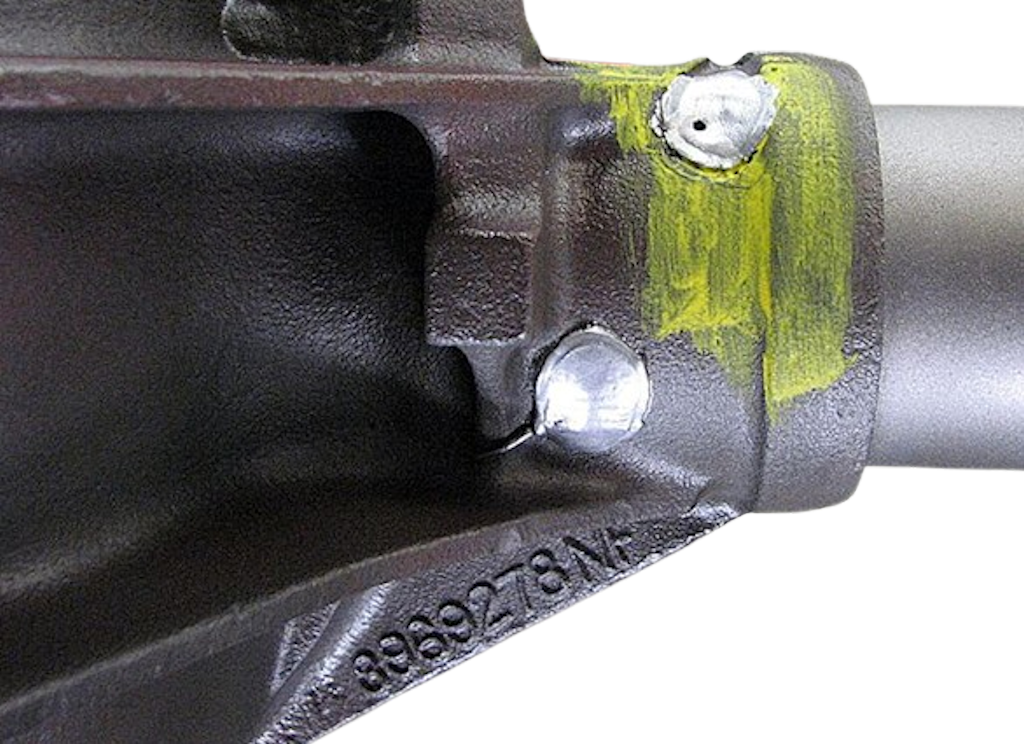
The yellow paint daub was applied to the rear end housing in
several areas such as this where the axle tubes meet the center
section.
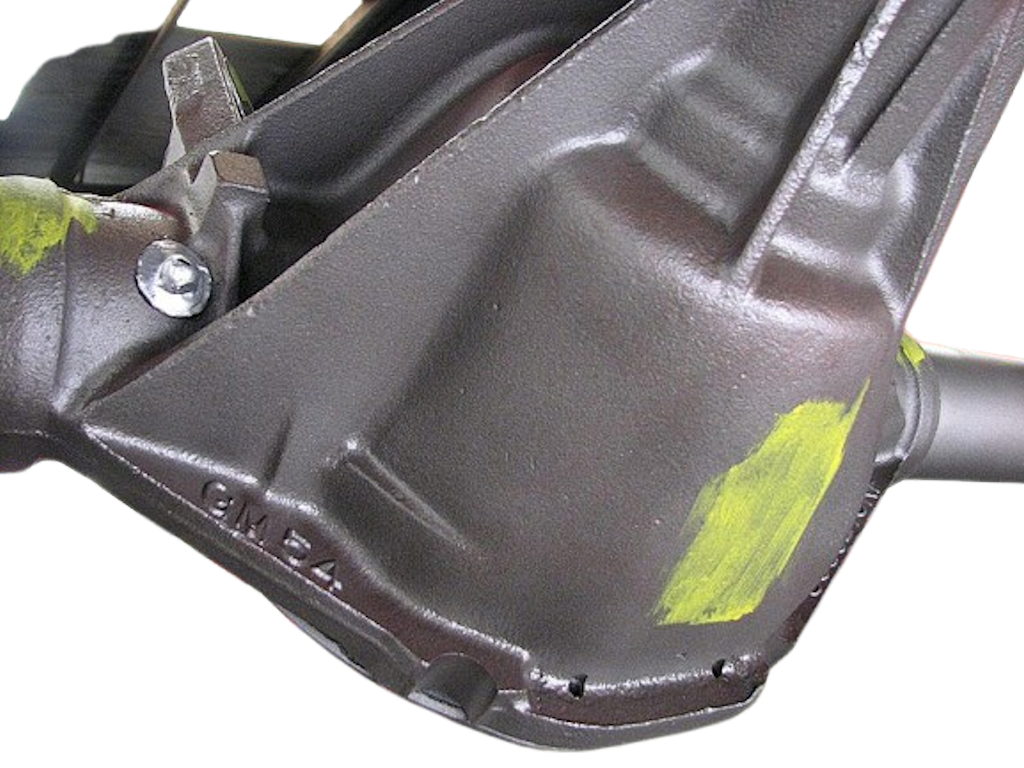
Yellow paint daub found on the underside of the rear end center
section indicating the rear end housing was ready for installation
and use.
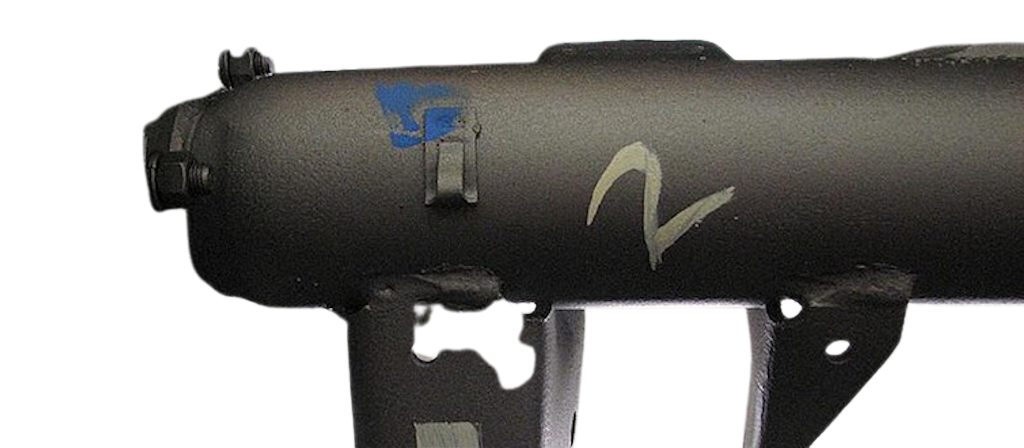
White paint daub found on rear shock mount and blue paint daub
on brake line clip. The exact significance of the white “Z” or “2”
is not known but could be the inspector’s identification mark.

Rear end assembly restored and ready to be installed in the chassis.
Note various colors of paint daubs to indicate they passed
inspection at their respective assembly/inspection stations.

Sometimes the entire rear end assembly was left in its natural
metal color instead of being painted black. There does not seem to
be a reason for one over the other.
Brake lines, both hard metal and flexible rubber lines, should be replaced as a matter of safety if nothing else.

Original rear end housing brake line distribution block. The
single center hose is a rubber composite to allow for flexibility
while the two lines to the rear brake cylinders are hard lines.
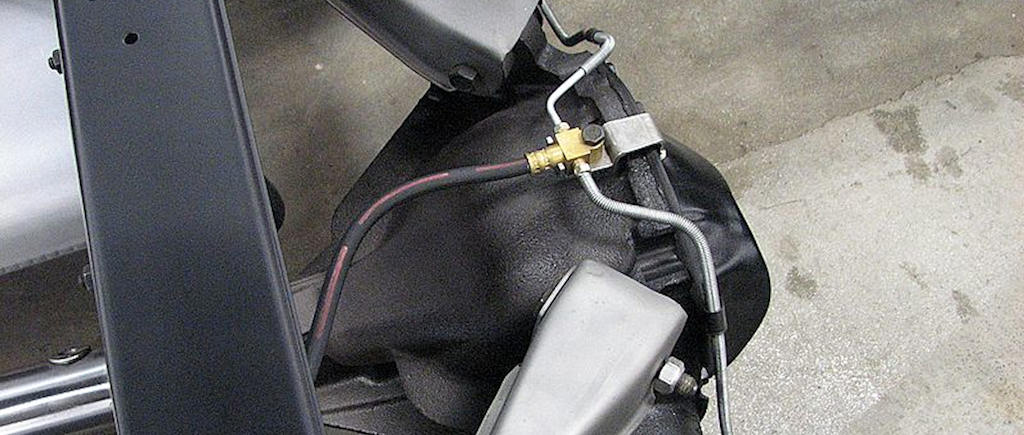
Restored rear end assembly installed in the chassis. The
replacement of hoses and hard lines are not only show quality
restorations but a good idea from a safety standpoint after almost
50 years of use.